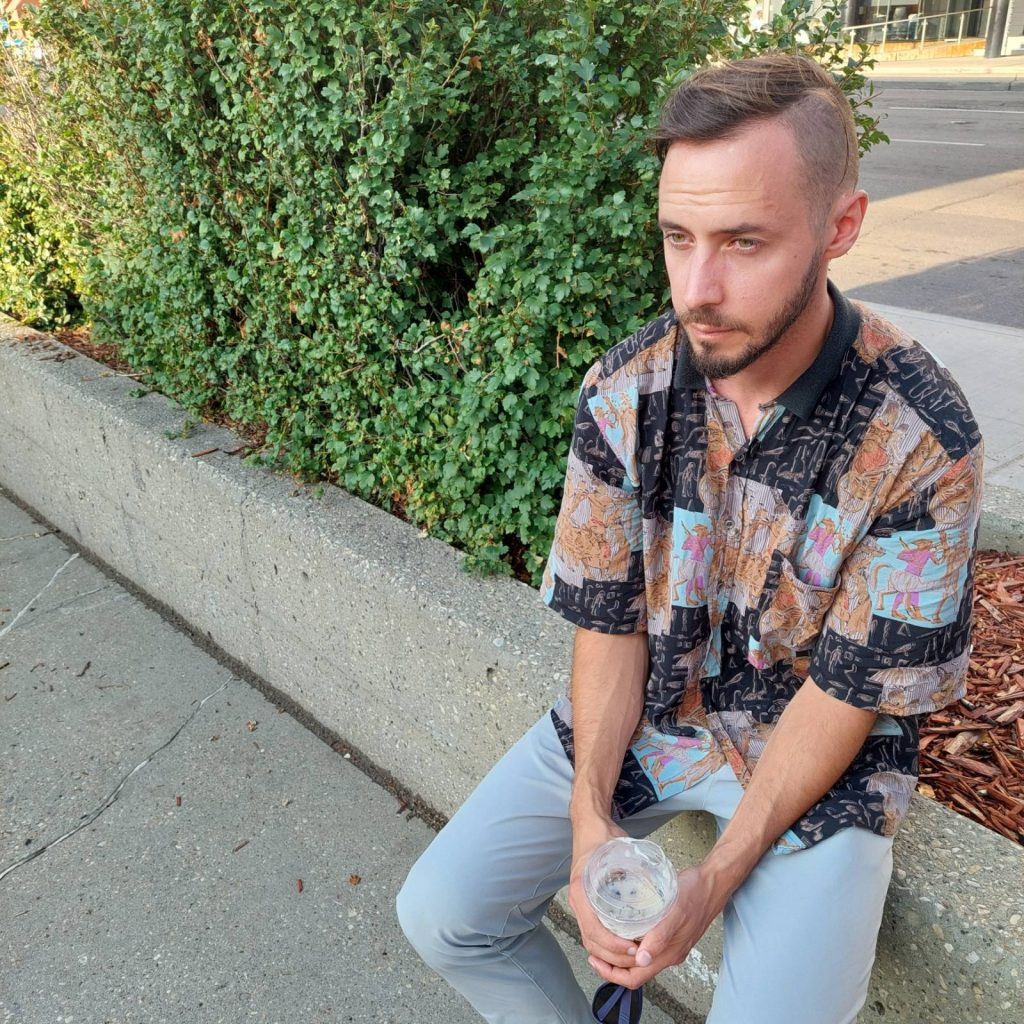
Last August, Quist Issue 2 contributor Adrien Thibault met with celebrated speculative fiction writer Rich Larson at Square Saint-Louis. They settled on a patch of grass and, over the chatter of other sun-seekers and the drone of planes passing overhead, had a wide-ranging conversation about Rich’s creative life that touched on worldbuilding, visual media as inspiration, the adaptation process, and breaking into publishing as a young writer. What follows is a condensed version of their conversation.
Adrien Thibault:
I read your story “Ice,” and I realized you managed to fit a lot of worldbuilding in a small number of paragraphs—and I wondered—when you write, how much do you plan beforehand, and how much do you improvise as you go?
Rich Larson:
My big idea in worldbuilding is I subscribe to Iceberg Theory. You can give the appearance of a nuanced, complex history in a setting between characters with just a few small details. In genre fiction especially, readers have so much stored-up imagery and knowledge that you’re able to prod a few neurons and they’ll meet you halfway and do a lot of the work themselves. That’s the better way to do it. Having a mystery and letting the reader imagine for me is almost always better.
Regarding planning—I usually write first sentence to last. I’m not much of an outliner. But when I’m starting something, within the first scene or two, I’ll be a lot looser and more frivolous with what details I’m adding in. It’s kind of like scattering a bunch of seeds. As I’m going through the story and finding my way to an ending, I already have all these ideas I can play with. I see which ones fit best, and then when I reach the end, I go back and strain out some of the more extraneous ideas, and clarify or sharpen the ones that become important to the narrative or the emotional arc or the character. Just giving myself a lot of raw material from the start gives the illusion of a really complex world, but it also gives me more options for the narrative as a writer.
“Having a mystery and letting the reader imagine for me is almost always better.”
—Rich Larson
AT:
Are there pieces of media that have inspired you, or where you’ve thought “Yeah, that was amazing, that was super cool”?
RL:
Oh yeah, tons. When I was a kid I read voraciously—like, a book a day kind of thing—and I think that’s what really cemented the universal grammar and the idea of “this is what a good sentence feels like or looks like.” But since high school I’ve been much more geared toward visual media. It’s almost like a dirty little secret, but I would much rather in most cases be watching a series or watching a film than sitting down and reading. Part of that is because writing is my job now, and I spend so much of my day reading anyway—whether I’m reading my own stuff, other people’s stuff, or if I’m doing work for hire, reading the briefs and the information I need to write. So I watch a lot more stuff than I read, and I get a lot of my inspiration that way. Maybe that’s why I’ve always written in a pretty visual way. When I’m writing a story I’m often trying to have this film camera…
AT:
It’s punchy.
RL:
Yeah, yeah, it’s cinematic. I like to be visualizing things as I’m writing them, so it always kind of made sense to me to draw inspiration from visual stuff. Recently, I thought I was done with Star Wars—I was so sick of Star Wars after the prequels, and there was Star Wars everywhere, and I hated it. Then a friend kept bugging me to watch Andor, so I started watching—and it’s good! Before that, I was really into Severance, like many people. It’s a really good show, dark and funny, beautifully shot. It has kind of a retro-future aesthetic which is fun, so I love those two shows right now. And sure, others.
I get a lot of inspiration from watching things, either because I love it and I think, “Ooh, I want to do something like that but a little bit different,” or I’ll watch something and think “Wow, I don’t like that at all, I want to write something completely opposite from that.” You get inspiration from the negative shapes too.
AT:
Interesting! You write across several genres—horror, fantasy, science fiction—but you seem to gravitate toward science fiction. Is there a specific emotional reason why you’re driven toward futuristic stuff?
RL:
I think the big part is that I loved science fiction and fantasy when I was a kid. When I first started getting published, I was doing poetry, then literary fiction. I was writing a lot of short stories about depressed young Canadian men—it was my “write what you know” stage. I found that it was very difficult to imagine making any kind of living from it, because you sort of have to luck into a big prize, and then parlay that into a teaching position. There don’t seem to be many other avenues. Also, I was just starting to bore myself. So I remembered back to what I really enjoyed reading, and that was genre fiction. When I made the switch back into the genre, I discovered “Oh, there’s a built-in audience here, too.” Not a massive audience, but there are people who want this because it is sci-fi, or fantasy, or horror. Not because it’s on this list of recommended books. I found it a lot easier to actually make a living doing genre fiction.
“The reason why I gravitate toward futuristic stuff specifically, like science fiction, is because it’s sort of the tightrope between creativity and believability.”
—Rich Larson
The reason why I gravitate toward futuristic stuff specifically, like science fiction, is because it’s sort of the tightrope between creativity and believability. With fantasy you can kind of go wild and do whatever you like, but I always lose a tiny bit of investment when things seem too far out there. We can write incredibly far-out science fiction stuff, but there’s always at least the illusion that this could be. I like to conserve that when possible.
Also, I’m always interested in what is developing and happening now. A lot of the time, fantasy can have more of a historical bent or feel to it, or it can be more focused on one character’s journey and their arc. Whereas historically and now, I think science fiction tends to focus more on society and the way it is changing. It’s not a scrying glass to see the future, it’s more like a mirror—the black mirror!—
AT:
Ha-ha.
RL:
—through which we look back at ourselves and see ourselves more clearly because of the distance.
“Science fiction is sort of a mirror—the black mirror!—through which we look back at ourselves and see ourselves more clearly because of the distance.”
—Rich Larson
That appeals to me about science fiction. No matter what I do, it’s sort of near-future, extrapolating from what’s happening now. Of course, trying to predict the future is a fool’s errand. You can always say “Oh, wow, look at this prediction from the 1970s that came true,” and then there’s a hundred other things that are so stupid, but you remember the one that actually did. I don’t try to be prescient, but my work is generally informed by what’s going on around me.
AT:
Is there a specific part of modern society that is inspiring, if you were to write something, for example, now?
RL:
I write a lot of stuff that examines technological development, and how human relationships bend through the prism of new technologies. So many things about “the rise of AI,” in scare quotes—these apply statistics on an absolutely massive scale that I feel like science fiction writers are kind of responsible for. They’re the ones that popularized this idea of AI as something that thinks, and that’s like your little buddy that can help you out. Then of course these tech companies have seized upon that, and it’s like “here’s your little buddy to help you out!” It’s not your little buddy. It’s really not. There’s no thinking machine, and I think it’s a very, very bad development.
“I write a lot of stuff that examines technological development, and how human relationships bend through the prism of new technologies.”
—Rich Larson
A lot of the stuff that I write right now has elements of talking about the algorithm, and critiquing where it could go, and how we got here.
AT:
I believe “Ice” was transformed into an episode of LOVE DEATH + ROBOTS—how does it feel to have your baby you created transformed into somebody else’s expression of your work?
RL:
It was cool. It was done by a Canadian artist-director named Robert Valley based out in Vancouver, so it was neat to have another Canadian working on it. But I had zero input. Basically I sold the rights—the adaptation rights—I think that must have been 2018—and then it was just radio silence. I wasn’t even sure if it was happening, and then I saw the trailer, and I saw the part where the whale pops out, and I was like “Woah! It’s my story!” So I had zero input in the adaptation process, and I’m glad that it turned out as good as it did.
It is its own thing now. Someone else’s baby. They changed a lot of the dialogue, they just ripped it out and put in their own dialogue, they tweaked the ending. The ending of the original story is quite depressing, and they decided for whatever reason to give this one more of an optimistic twist. I think it works as its own thing, but it’s important to me when doing any kind of either work for hire or getting stuff adapted, translated, to be like “okay, this is your baby now, it’s not mine.” Otherwise it would drive me a little bit crazy. I always have the idea that what I wrote originally, that’s my version of it, but people can make their own equally valid, sometimes better, versions, and I can be okay with that.
AT:
It’s common for people to say things like, “So-and-so famous author was rejected 249 times before they got their bestseller published.” This can be discouraging, especially for young people trying to get published for the first time. How old were you when you got your first acceptance, and after how many rejections? Would you say rejection is an important part of growth? Do you have any advice for young writers who have just started querying?
RL:
I got my start with contests (hosted by my local library) and magazines geared toward younger writers, like The Adroit Journal and The Claremont Review. Around eighteen, I started submitting to professional markets. Rejection is inevitable in the short fiction ecosystem. Clarkesworld Magazine, for example, rejected thirty-seven of my stories before buying one. I’ve published twenty stories with them since, but that doesn’t mean I cracked the code—they still reject me plenty. Past a certain threshold of quality, these decisions come down to taste and fit. Even really good stories often take a few tries to find the right home.
“Loving the process and developing a thick skin are two of the most important things you can do as a young writer.”
—Rich Larson
Getting representation for my first novel also involved a lot of rejection. At nineteen, I was a finalist for the Amazon Breakthrough Novel Award, which was great for my confidence—but also made me think selling a novel would be a cinch. Instead, it took six years, three unpublishable books, and a ton of querying before I got an agent and a book deal.
Loving the process and developing a thick skin are two of the most important things you can do as a young writer. I sometimes wonder about all the skilled writers who were never published because they didn’t make it through the initial barrage of rejection letters.
Adrien Thibault is a first-year law student who never grew out of his dinosaur phase. He lives in Montreal with his seven birds. When he isn’t writing, he’s making terrible low-budget films with his friends. His speculative fiction story “Heartfelt Baloney” appears in Quist Issue 2.
Rich Larson was born in Galmi, Niger, has lived in Spain and Czech Republic, and currently writes from Montreal, Canada. He is the author of the novels Ymir and Annex, as well as the collection Tomorrow Factory. His fiction has been translated into over a dozen languages, including Polish, Italian, Romanian, and Japanese, and adapted into an Emmy-winning episode of LOVE DEATH + ROBOTS. His latest flash collection, The Sky Didn’t Load Today and Other Glitches, was published this summer by Flame Arrow Publishing. Find Rich at instagram.com/richlarsonwrites or patreon.com/richlarson.