
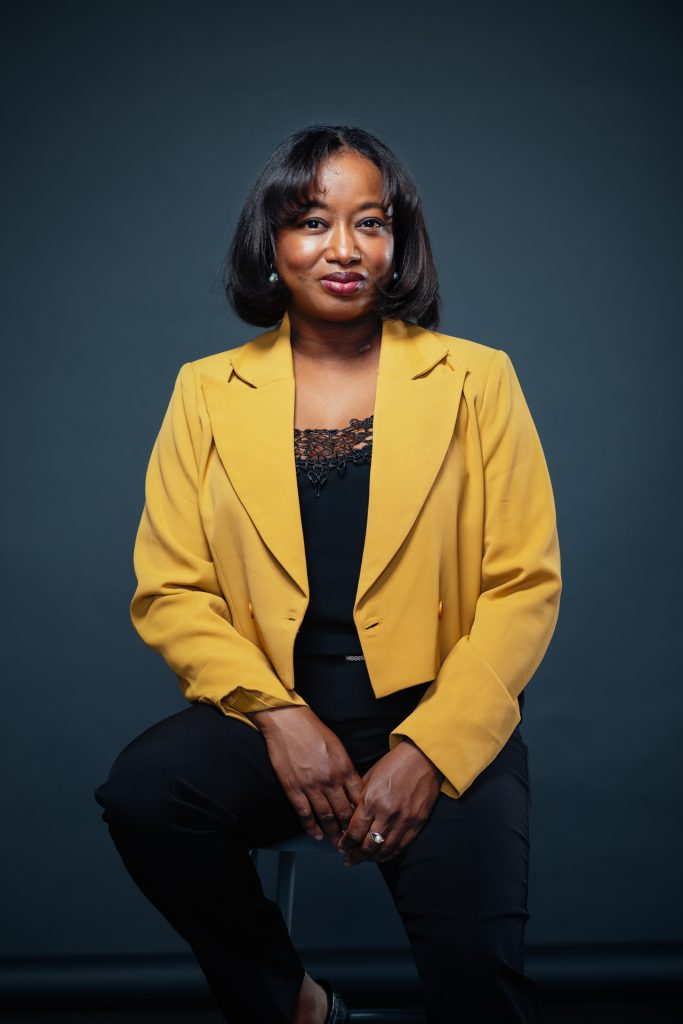
In early April, Issue 3 contributor Maya Mohammad sat down with Chanel Sutherland to talk about memory, displacement, oral tradition, and the transformative power of small human moments—all on the eve of the publication of Chanel’s debut story collection, Layaway Child (House of Anansi Press, spring 2026). Despite the distance of Zoom, the exchange was warm and reflective. The following conversation has been edited for length and clarity.
Maya Mohammad:
As I read your pieces, questions that kept recurring for me were related to your creative process. I’m really intrigued by it because my own writing is also very emotionally grounded. How are you able to create linear, coherent narratives without getting stuck in the rabbit holes of your memories?
Chanel Sutherland:
I think any piece I write starts with memory. Whether it’s a story, a poem, or an essay, it’s triggered by something that happened to me or someone close to me that I’m trying to make sense of. I spend a lot of time thinking and reflecting; I’ve always been that child you can find under a tree, daydreaming. So I do process a lot before I write. I work through a memory until I come to some understanding, and the next stage in making sense of it is to write it down in whatever form it presents itself. It’s usually just freewriting from there—it only makes sense to me at the end, once I’ve completed the piece, why I needed to write about it.
“I’ve always been that child you can find under a tree, daydreaming.”
—Chanel Sutherland
MM:
Going back to Layaway Child, are these stories inspired by your own journey in the same way? How did you tackle revisiting these emotionally heavy memories?
CS:
I’ve been writing Layaway Child since I was sixteen. It took a long time because it deals with my own experiences of being uprooted from everything I knew in the Caribbean and transplanted to Montreal. There’s something of me in every single story. Mental health is important to me, and I need to be mentally healthy in order to approach art, so I had to step away from the work for a while. The COVID years were actually generative in an unexpected way—I was walking with my mom and having conversations we’d never had before. Writing the book ended up being a healing process; it meant revisiting experiences I hadn’t allowed myself to confront until I was ready to write them.
MM:
Mentioning the many conversations you were having with family members—did it provoke moments of reckoning? I wonder at the vulnerability that was needed from both you and them to be in that space, share the stories, up until the publishing process of putting it out in the world.
CS:
I’m lucky that my family is supportive. My mom knows the stories best—we talked about which ones felt right to tell. These moments weren’t so much reckonings as recognition between the two of us; me finally understanding the sacrifices she made, and her understanding what I went through as an immigrant child. We bonded and became a little closer because we finally understood each other’s experiences.
I was reluctant to put the stories out into the world, but when I started getting feedback from readers of my previously published work, there was a sense that these stories were needed, and I got a bit of courage from that.
“These moments weren’t so much reckonings as recognition.”
—Chanel Sutherland
MM:
What struck me most in your writing were your vivid descriptions, especially in “Beneath the Softness of Snow.” The immersive depiction of the brutal Canadian weather and the Montreal cityscape put me in the character’s head as I went through the narrative. How does landscape pervade your storytelling?
CS:
I’m a child of the Caribbean because I spent my first ten years there, so that landscape marked me—and it’s the polar opposite of Montreal’s. It was such a sudden difference, arriving in this cold, huge cosmopolitan city from a small village surrounded by beautiful nature, where you can go pick a fruit from the garden. My first impressions of Montreal imprinted themselves on my brain, so a part of me is pulling back to the Caribbean as a way to counteract the starkness. Although I now love Montreal and it’s become home, there is still a duality between the two. As I fall more in love with Montreal, the Caribbean part of me gets a little bit jealous. The contrast in the two landscapes has become a natural part of my creative process.
“As I fall more in love with Montreal, the Caribbean part of me gets a little bit jealous.”
—Chanel Sutherland
MM:
On your author’s page [cssuther.com], you describe your “early immersion in storytelling” as having shaped you into “a writer who believes in the transformative power of words.” What are the stories or novels that still stick with you in your creative process today?
CS:
I Know Why the Caged Bird Sings by Maya Angelou. Reading that book at sixteen years old, it was the first time that I realized I could write stories like my own. It was given to me by my high school teacher after I expressed that I wanted to be a writer, and I immediately saw myself in that book. I thought, “People write about things that I’ve gone through!”
This teacher, by the way, has been so important to my career. In high school, she actively pushed me towards becoming a writer. Just being seen like that was wonderful—one small thing can have an important impact on a kid, and I was lucky to have her.
MM:
You mentioned your grandmother telling you stories growing up. I wonder what the role of generational storytelling and the transmission of oral history in your community has had in your writing practice.
CS:
My grandmother was a wonderful storyteller. I grew up wanting to be a storyteller like her before I realized that people wrote stories. An important space for oral traditions in the village I grew up in is the church. I was more interested in the stories than in the religious aspect of Sunday school. When the community would get together before or after church, the adults would talk about the news and rumours, and I would stand in a corner listening to it all. And listening to my grandmother tell stories under the stars—these are the moments that made a huge impression on me, and that’s why I wanted to be a storyteller.
MM:
It sounds like storytelling, for you, is deeply connected to community and shared experience in a way that feels different from the solitude of writing or reading.
CS:
I think this is how storytelling began. Our ancestors spoke to each other as a way to share information, and I’ve always been drawn to that. There is a human need for storytelling—even in my darkest moments, I go back to it. And while reading is wonderful, being told a story and being able to tell a story—this act of sharing—feels very rejuvenating. The physicality, the environment, the experience of being in the company of others—the collective—feeds my actual writing.
“I try to write about the smallest, most human, mundane moments.”
—Chanel Sutherland
MM:
Your work often focuses on small, intimate moments, but they end up feeling larger than the individual experience. Is that part of what you mean by the “transformative power of words?”
CS:
Whenever I approach a story, I try to write about the smallest, most human, mundane moments. I think this is what connects everyone across generations, regardless of race, class, culture, or age. Being human is being mundane. Even with the big issues happening in the world, I try to find a small human thing we can recognize ourselves in, and maybe that can be a bridge to empathy or understanding somebody else, which is transformative, I think.
MM:
Maybe pessimistically, it seems we tend to see the differences among one another rather than the connections, but I find we all indeed share some habits, needs, and desires for community.
CS:
I think stories are one of the ways we bridge those differences. Reading is one of the only moments where we listen, and we’re not inclined to interrupt. You’re reading somebody else’s words, and it’s forcing you to slow down and think about how that sentence or that experience might fit into your life. I believe that’s why stories about small moments are so important, just as important as stories about big moments.
Maya Mohammad is a Franco-Indian writer based in Montreal, where they study sociology, communication, and gender studies at McGill University. Their poetry appears in The Imagist and Snaps. Find them on Instagram @oeilde.tigre or at mayasnebulousness.bearblog.dev.